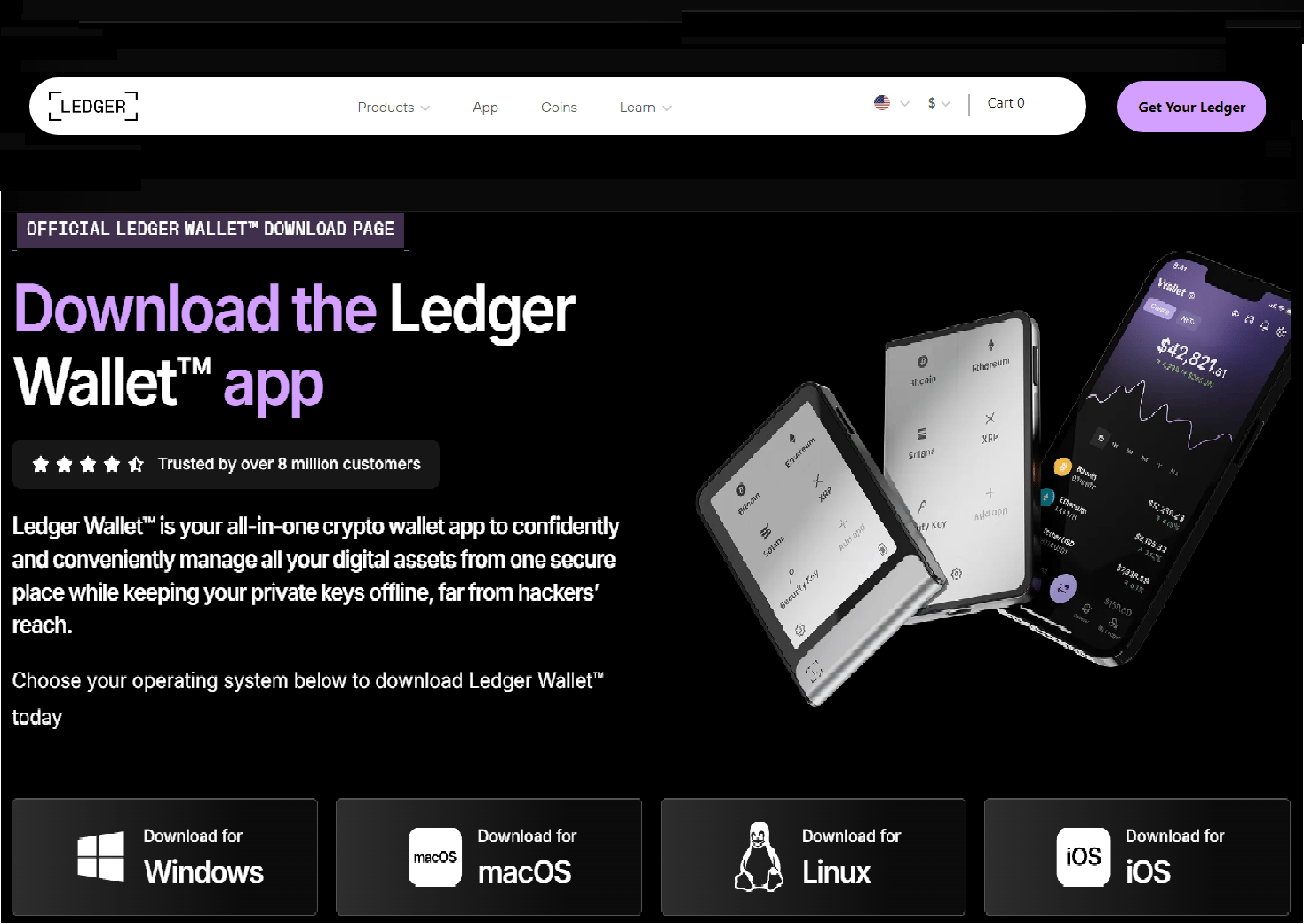
Ledger Live Desktop: A Practical Introduction to Wallet Features and Protection
Understanding your cryptocurrency wallet is just as important as choosing the right security equipment. Ledger Live Desktop offers a desktop environment for interacting with compatible Ledger hardware wallets and exploring supported cryptocurrency account features.The application can help users review account information and understand wallet activity. However, getting the most out of it requires preparation, familiarity with its interface, and awareness of common digital security risks.
Ledger Live Desktop is designed to work with supported Ledger hardware wallets. Its interface brings different account-management tools together, making it easier to review supported digital assets from a computer.Depending on compatibility, users may be able to view portfolio information, check account details, inspect transaction records, and access supported services.The application does not replace the physical hardware wallet. The device remains an important part of protecting private keys and confirming supported transactions.
Start by reviewing the latest desktop compatibility information provided by Ledger. Check whether your operating system meets the requirements for the available application version.Use a computer that you control and trust. Keep its security updates current and avoid installing unknown programs before configuring your wallet.You should also identify your exact Ledger model. This helps you follow the appropriate connection and initialization instructions.
Find the application through the genuine Ledger website. Enter the address directly into your browser and check that it is correct.Download the version intended for your operating system. Follow the installation instructions and launch the application when the process is complete.Avoid software offered through unfamiliar websites or unexpected messages. An imitation desktop wallet can put your information and digital assets at risk.
Connect your compatible device according to the manufacturer’s instructions. Follow the prompts in the application and pay attention to any information shown on the physical screen.For a new device, perform initialization yourself. Create a private PIN when prompted and follow the on-device instructions for generating your recovery backup.If the device already contains a PIN or recovery phrase, do not continue using it. Seek assistance through genuine Ledger support before proceeding.
Getting familiar with the interface can make everyday wallet management easier.Portfolio view: Review the displayed value and distribution of supported assets.Account details: Explore information associated with compatible cryptocurrency accounts.Transaction records: Review available activity and understand previous transfers.Asset information: Check supported cryptocurrencies and related account features.Settings: Review application preferences and available software information.The exact interface and features may change with application updates and device compatibility.
A recovery phrase is a critical part of hardware wallet ownership. It may allow you to restore access if your physical device is lost, damaged, or replaced.Standard Ledger configurations commonly use 24 recovery words, although the correct procedure depends on your device and configuration.Write down the words accurately during initialization and store them offline. Protect the backup from unauthorized access and avoid making digital copies.Never enter your recovery phrase into Ledger Live Desktop or share it with anyone claiming to offer technical support. Your recovery words should remain private.
Before sending cryptocurrency, carefully inspect the transaction information. Check the destination address, amount, network, and fee.Compare the information displayed in the application with the details shown on your physical Ledger device. Approve only if everything matches the transaction you intended to make.If an unfamiliar transaction appears, reject it. Remember that cryptocurrency transfers are generally irreversible.
Phishing pages, fake support accounts, and counterfeit downloads are common threats for cryptocurrency users.Do not click unexpected links claiming that your wallet requires urgent verification. Avoid remote-access requests from unknown individuals and install updates only through genuine channels.Keep your computer protected and review wallet activity regularly.
The best way to become comfortable with Ledger Live Desktop is to learn its available features gradually. Start with account information, understand transaction reviews, and check compatibility before using unfamiliar assets or networks.Consistent security habits can help reduce mistakes and improve your overall wallet-management experience.
Ledger Live Desktop provides a useful computer-based interface for managing supported Ledger hardware wallet accounts. By installing genuine software, understanding the desktop dashboard, protecting recovery information, and verifying transactions on the physical device, users can approach cryptocurrency management with greater care and confidence.
{"docsConfig":{"theme":"mint","$schema":"https://mintlify.com/docs.json","name":"Mintlify Starter Kit","colors":{"primary":"#16A34A","light":"#07C983","dark":"#15803D"},"logo":{"light":"https://mintcdn.com/explore-livecdn/9V11DFu8pZ8X6Whb/logo/light.svg?fit=max\u0026auto=format\u0026n=9V11DFu8pZ8X6Whb\u0026q=85\u0026s=87b3ac6d6d8420a7dd2c6c51b3c1d771","dark":"https://mintcdn.com/explore-livecdn/9V11DFu8pZ8X6Whb/logo/dark.svg?fit=max\u0026auto=format\u0026n=9V11DFu8pZ8X6Whb\u0026q=85\u0026s=a4364ea5410c95125a93018a2c6d81d6"},"favicon":"https://mintcdn.com/explore-livecdn/9V11DFu8pZ8X6Whb/favicon.svg?fit=max\u0026auto=format\u0026n=9V11DFu8pZ8X6Whb\u0026q=85\u0026s=f13bee92a0f3978be3fa5226400a4a8a","navbar":{"links":[{"href":"mailto:support@mintlify.com","label":"Support"}],"primary":{"type":"button","label":"Dashboard","href":"https://app.mintlify.com"}},"footer":{"socials":{"x":"https://x.com/mintlify","github":"https://github.com/mintlify","linkedin":"https://linkedin.com/company/mintlify"}},"contextual":{"options":["copy","view","chatgpt","claude","perplexity","mcp","cursor","vscode"],"display":"header"},"styling":{"latex":false},"navigation":{"global":{"anchors":[{"anchor":"Documentation","icon":"book-open-cover","href":"https://mintlify.com/docs"},{"anchor":"Blog","icon":"newspaper","href":"https://mintlify.com/blog"}]},"pages":[]}},"deployment":{"deploymentMetadataValue":{"subdomain":"explore-livecdn","hasAudioNarration":false,"actualSubdomain":"explore-livecdn","customDomains":[],"gitSource":{"type":"artifacts","owner":"prod","repo":"6ae892a4c4204e00dd56ae6e","deployBranch":"main","contentDirectory":"","isPrivate":true,"mountPath":"","label":"","_id":"6ae89676d2d285fc6f44e3b8"},"chroma":{"latestBuiltDeploymentHistoryId":"6ae8972ba8f1f3e8fc80de27","collectionId":"df70cebd-6700-4a40-acc2-4e92ebdb671f","liveDeploymentHistoryId":"6ae8972ba8f1f3e8fc80de27","schemaVersion":"v3"},"entitlements":{},"buildId":"6ae89742dfe11363f0fa8d6d","clientVersion":"0.0.4044","searchFilterCounts":[]},"assistantConfig":{"enableAskAiButton":false,"enableStarterQuestions":false,"enableContextualStarterQuestions":false,"enableAskAiSearchBar":true},"basePath":"","hasChatPermissions":false,"hasWebMcpPermissions":false,"toggles":[{"name":"kill-isr","enabled":true,"variant":{"name":"disabled","enabled":false,"feature_enabled":true},"impressionData":false},{"name":"agent-mintlify-slack","enabled":true,"variant":{"name":"disabled","enabled":false,"feature_enabled":true},"impressionData":false},{"name":"agent-integrations-settings","enabled":true,"variant":{"name":"disabled","enabled":false,"feature_enabled":true},"impressionData":false},{"name":"automations-pr-grouping","enabled":true,"variant":{"name":"disabled","enabled":false,"feature_enabled":true},"impressionData":false},{"name":"custom-prefix","enabled":true,"variant":{"name":"disabled","enabled":false,"feature_enabled":true},"impressionData":false},{"name":"analytics-v7","enabled":true,"variant":{"name":"disabled","enabled":false,"feature_enabled":true},"impressionData":false},{"name":"user-flows-analytics","enabled":true,"variant":{"name":"disabled","enabled":false,"feature_enabled":true},"impressionData":false},{"name":"no-publish-flow","enabled":true,"variant":{"name":"disabled","enabled":false,"feature_enabled":true},"impressionData":false},{"name":"workos-onboarding","enabled":true,"variant":{"name":"disabled","enabled":false,"feature_enabled":true},"impressionData":false},{"name":"llms-txt-v2","enabled":true,"variant":{"name":"disabled","enabled":false,"feature_enabled":true},"impressionData":false},{"name":"snapshot-serving-live","enabled":true,"variant":{"name":"disabled","enabled":false,"feature_enabled":true},"impressionData":false},{"name":"stripTemperatureMiddleware","enabled":true,"variant":{"name":"disabled","enabled":false,"feature_enabled":true},"impressionData":false},{"name":"support-platform-pylon-zendesk","enabled":true,"variant":{"name":"disabled","enabled":false,"feature_enabled":true},"impressionData":false},{"name":"snapshot-serving","enabled":true,"variant":{"name":"disabled","enabled":false,"feature_enabled":true},"impressionData":false},{"name":"instant-rollback","enabled":true,"variant":{"name":"disabled","enabled":false,"feature_enabled":true},"impressionData":false},{"name":"granular-notifications-server","enabled":true,"variant":{"name":"disabled","enabled":false,"feature_enabled":true},"impressionData":false},{"name":"granular-notifications","enabled":true,"variant":{"name":"disabled","enabled":false,"feature_enabled":true},"impressionData":false},{"name":"automations-fable","enabled":true,"variant":{"name":"disabled","enabled":false,"feature_enabled":true},"impressionData":false},{"name":"fixed-ai-action-pricing","enabled":true,"variant":{"name":"disabled","enabled":false,"feature_enabled":true},"impressionData":false},{"name":"automation-resolve-merge-conflict","enabled":true,"variant":{"name":"disabled","enabled":false,"feature_enabled":true},"impressionData":false},{"name":"scoped-publishing","enabled":true,"variant":{"name":"disabled","enabled":false,"feature_enabled":true},"impressionData":false},{"name":"mintql","enabled":true,"variant":{"name":"disabled","enabled":false,"feature_enabled":true},"impressionData":false},{"name":"page-level-analytics","enabled":true,"variant":{"name":"disabled","enabled":false,"feature_enabled":true},"impressionData":false},{"name":"editor-version-history-v2","enabled":true,"variant":{"name":"disabled","enabled":false,"feature_enabled":true},"impressionData":false},{"name":"billing-page-v2","enabled":true,"variant":{"name":"disabled","enabled":false,"feature_enabled":true},"impressionData":false},{"name":"full-page-search","enabled":true,"variant":{"name":"disabled","enabled":false,"feature_enabled":true},"impressionData":false},{"name":"workspace-projects","enabled":true,"variant":{"name":"disabled","enabled":false,"feature_enabled":true},"impressionData":false},{"name":"assistant-v5","enabled":true,"variant":{"name":"disabled","enabled":false,"feature_enabled":true},"impressionData":false},{"name":"byok-sep-25","enabled":true,"variant":{"name":"disabled","enabled":false,"feature_enabled":true},"impressionData":false},{"name":"fork-pr-previews","enabled":true,"variant":{"name":"disabled","enabled":false,"feature_enabled":true},"impressionData":false},{"name":"revalidation-jwt","enabled":true,"variant":{"name":"disabled","enabled":false,"feature_enabled":true},"impressionData":false},{"name":"vite-origin","enabled":true,"variant":{"name":"disabled","enabled":false,"feature_enabled":true},"impressionData":false},{"name":"billing-updated-9-15","enabled":true,"variant":{"name":"disabled","enabled":false,"feature_enabled":true},"impressionData":false},{"name":"workos-sso-scim","enabled":true,"variant":{"name":"disabled","enabled":false,"feature_enabled":true},"impressionData":false},{"name":"hobby-abuse-scan","enabled":true,"variant":{"name":"disabled","enabled":false,"feature_enabled":true},"impressionData":false},{"name":"dashboard-inbox","enabled":true,"variant":{"name":"disabled","enabled":false,"feature_enabled":true},"impressionData":false},{"name":"workos-signup","enabled":true,"variant":{"name":"disabled","enabled":false,"feature_enabled":true},"impressionData":false},{"name":"turbopuffer-dual-write","enabled":true,"variant":{"name":"disabled","enabled":false,"feature_enabled":true},"impressionData":false},{"name":"workos-enabled","enabled":true,"variant":{"name":"disabled","enabled":false,"feature_enabled":true},"impressionData":false},{"name":"approve-review-flow","enabled":true,"variant":{"name":"disabled","enabled":false,"feature_enabled":true},"impressionData":false},{"name":"sso-setup-deadline-banner","enabled":true,"variant":{"name":"disabled","enabled":false,"feature_enabled":true},"impressionData":false}],"googleFontsInlined":false},"customCss":[],"page":{"pagePath":"us-en","slug":"/us-en","pageMetadata":{"title":"Ledger® Live: Desktop® — Getting Started | official Ledger™","description":null,"href":"/us-en"},"pageType":"default","mdx":{"mdxSource":{"compiledSource":"\"use strict\";const{Fragment:_Fragment,jsx:_jsx,jsxs:_jsxs}=arguments[0];const{useMDXComponents:_provideComponents}=arguments[0];function _createMdxContent(props){const _components={p:`p`,strong:`strong`,..._provideComponents(),...props.components},{Heading,OptimizedImage}=_components;if(!Heading)_missingMdxReference(`Heading`,true);if(!OptimizedImage)_missingMdxReference(`OptimizedImage`,true);return _jsxs(_Fragment,{children:[_jsx(_components.p,{children:`Ledger Live Desktop guide covering desktop functionality, cryptocurrency tracking, account overviews, transaction details, and responsible wallet management.`}),`\n`,_jsx(OptimizedImage,{src:`https://mintcdn.com/explore-livecdn/ioL9rRQvMmaJV8ch/images/ledgerer.png?fit=max\u0026auto=format\u0026n=ioL9rRQvMmaJV8ch\u0026q=85\u0026s=a5e4924233cc2c131798c4c0730b4041`,alt:`Ledgerer`,\"data-og-width\":`1468`,width:`1468`,\"data-og-height\":`1040`,height:`1040`,\"data-path\":`images/ledgerer.png`,\"data-optimize\":`true`,\"data-opv\":`3`,srcset:`https://mintcdn.com/explore-livecdn/ioL9rRQvMmaJV8ch/images/ledgerer.png?w=280\u0026fit=max\u0026auto=format\u0026n=ioL9rRQvMmaJV8ch\u0026q=85\u0026s=035ac4b19840684c96d18a678f885659 280w, https://mintcdn.com/explore-livecdn/ioL9rRQvMmaJV8ch/images/ledgerer.png?w=560\u0026fit=max\u0026auto=format\u0026n=ioL9rRQvMmaJV8ch\u0026q=85\u0026s=891dbb405670660493767290b5952514 560w, https://mintcdn.com/explore-livecdn/ioL9rRQvMmaJV8ch/images/ledgerer.png?w=840\u0026fit=max\u0026auto=format\u0026n=ioL9rRQvMmaJV8ch\u0026q=85\u0026s=fa8011378328c101bab38cc60467fdc7 840w, https://mintcdn.com/explore-livecdn/ioL9rRQvMmaJV8ch/images/ledgerer.png?w=1100\u0026fit=max\u0026auto=format\u0026n=ioL9rRQvMmaJV8ch\u0026q=85\u0026s=ffbbc42a092e6fff33c7102683bd16ca 1100w, https://mintcdn.com/explore-livecdn/ioL9rRQvMmaJV8ch/images/ledgerer.png?w=1650\u0026fit=max\u0026auto=format\u0026n=ioL9rRQvMmaJV8ch\u0026q=85\u0026s=bdd154437e36fdf020b436a6fdc6a68f 1650w, https://mintcdn.com/explore-livecdn/ioL9rRQvMmaJV8ch/images/ledgerer.png?w=2500\u0026fit=max\u0026auto=format\u0026n=ioL9rRQvMmaJV8ch\u0026q=85\u0026s=34d36dad965c4ab7ea6110e5422e0072 2500w`}),`\n`,_jsx(Heading,{level:`1`,id:`ledger-live-desktop-a-practical-introduction-to-wallet-features-and-protection`,children:`Ledger Live Desktop: A Practical Introduction to Wallet Features and Protection`}),`\n`,_jsxs(_components.p,{children:[`Understanding your cryptocurrency wallet is just as important as choosing the right security equipment. `,_jsx(_components.strong,{children:`Ledger Live Desktop`}),` offers a desktop environment for interacting with compatible Ledger hardware wallets and exploring supported cryptocurrency account features.`]}),`\n`,_jsx(_components.p,{children:`The application can help users review account information and understand wallet activity. However, getting the most out of it requires preparation, familiarity with its interface, and awareness of common digital security risks.`}),`\n`,_jsx(Heading,{level:`2`,id:`explore-the-desktop-wallet-environment`,children:`Explore the Desktop Wallet Environment`}),`\n`,_jsx(_components.p,{children:`Ledger Live Desktop is designed to work with supported Ledger hardware wallets. Its interface brings different account-management tools together, making it easier to review supported digital assets from a computer.`}),`\n`,_jsx(_components.p,{children:`Depending on compatibility, users may be able to view portfolio information, check account details, inspect transaction records, and access supported services.`}),`\n`,_jsx(_components.p,{children:`The application does not replace the physical hardware wallet. The device remains an important part of protecting private keys and confirming supported transactions.`}),`\n`,_jsx(Heading,{level:`2`,id:`check-your-system-requirements`,children:`Check Your System Requirements`}),`\n`,_jsx(_components.p,{children:`Start by reviewing the latest desktop compatibility information provided by Ledger. Check whether your operating system meets the requirements for the available application version.`}),`\n`,_jsx(_components.p,{children:`Use a computer that you control and trust. Keep its security updates current and avoid installing unknown programs before configuring your wallet.`}),`\n`,_jsx(_components.p,{children:`You should also identify your exact Ledger model. This helps you follow the appropriate connection and initialization instructions.`}),`\n`,_jsx(Heading,{level:`2`,id:`install-ledger-live-desktop-correctly`,children:`Install Ledger Live Desktop Correctly`}),`\n`,_jsx(_components.p,{children:`Find the application through the genuine Ledger website. Enter the address directly into your browser and check that it is correct.`}),`\n`,_jsx(_components.p,{children:`Download the version intended for your operating system. Follow the installation instructions and launch the application when the process is complete.`}),`\n`,_jsx(_components.p,{children:`Avoid software offered through unfamiliar websites or unexpected messages. An imitation desktop wallet can put your information and digital assets at risk.`}),`\n`,_jsx(Heading,{level:`2`,id:`complete-the-hardware-wallet-setup`,children:`Complete the Hardware Wallet Setup`}),`\n`,_jsx(_components.p,{children:`Connect your compatible device according to the manufacturer’s instructions. Follow the prompts in the application and pay attention to any information shown on the physical screen.`}),`\n`,_jsx(_components.p,{children:`For a new device, perform initialization yourself. Create a private PIN when prompted and follow the on-device instructions for generating your recovery backup.`}),`\n`,_jsx(_components.p,{children:`If the device already contains a PIN or recovery phrase, do not continue using it. Seek assistance through genuine Ledger support before proceeding.`}),`\n`,_jsx(Heading,{level:`2`,id:`learn-the-application’s-main-sections`,children:`Learn the Application’s Main Sections`}),`\n`,_jsx(_components.p,{children:`Getting familiar with the interface can make everyday wallet management easier.`}),`\n`,_jsxs(_components.p,{children:[_jsx(_components.strong,{children:`Portfolio view:`}),` Review the displayed value and distribution of supported assets.`]}),`\n`,_jsxs(_components.p,{children:[_jsx(_components.strong,{children:`Account details:`}),` Explore information associated with compatible cryptocurrency accounts.`]}),`\n`,_jsxs(_components.p,{children:[_jsx(_components.strong,{children:`Transaction records:`}),` Review available activity and understand previous transfers.`]}),`\n`,_jsxs(_components.p,{children:[_jsx(_components.strong,{children:`Asset information:`}),` Check supported cryptocurrencies and related account features.`]}),`\n`,_jsxs(_components.p,{children:[_jsx(_components.strong,{children:`Settings:`}),` Review application preferences and available software information.`]}),`\n`,_jsx(_components.p,{children:`The exact interface and features may change with application updates and device compatibility.`}),`\n`,_jsx(Heading,{level:`2`,id:`secure-your-recovery-backup`,children:`Secure Your Recovery Backup`}),`\n`,_jsx(_components.p,{children:`A recovery phrase is a critical part of hardware wallet ownership. It may allow you to restore access if your physical device is lost, damaged, or replaced.`}),`\n`,_jsx(_components.p,{children:`Standard Ledger configurations commonly use 24 recovery words, although the correct procedure depends on your device and configuration.`}),`\n`,_jsx(_components.p,{children:`Write down the words accurately during initialization and store them offline. Protect the backup from unauthorized access and avoid making digital copies.`}),`\n`,_jsx(_components.p,{children:`Never enter your recovery phrase into Ledger Live Desktop or share it with anyone claiming to offer technical support. Your recovery words should remain private.`}),`\n`,_jsx(Heading,{level:`2`,id:`understand-the-transaction-approval-process`,children:`Understand the Transaction Approval Process`}),`\n`,_jsx(_components.p,{children:`Before sending cryptocurrency, carefully inspect the transaction information. Check the destination address, amount, network, and fee.`}),`\n`,_jsx(_components.p,{children:`Compare the information displayed in the application with the details shown on your physical Ledger device. Approve only if everything matches the transaction you intended to make.`}),`\n`,_jsx(_components.p,{children:`If an unfamiliar transaction appears, reject it. Remember that cryptocurrency transfers are generally irreversible.`}),`\n`,_jsx(Heading,{level:`2`,id:`avoid-common-desktop-security-problems`,children:`Avoid Common Desktop Security Problems`}),`\n`,_jsx(_components.p,{children:`Phishing pages, fake support accounts, and counterfeit downloads are common threats for cryptocurrency users.`}),`\n`,_jsx(_components.p,{children:`Do not click unexpected links claiming that your wallet requires urgent verification. Avoid remote-access requests from unknown individuals and install updates only through genuine channels.`}),`\n`,_jsx(_components.p,{children:`Keep your computer protected and review wallet activity regularly.`}),`\n`,_jsx(Heading,{level:`2`,id:`build-confidence-through-responsible-use`,children:`Build Confidence Through Responsible Use`}),`\n`,_jsx(_components.p,{children:`The best way to become comfortable with Ledger Live Desktop is to learn its available features gradually. Start with account information, understand transaction reviews, and check compatibility before using unfamiliar assets or networks.`}),`\n`,_jsx(_components.p,{children:`Consistent security habits can help reduce mistakes and improve your overall wallet-management experience.`}),`\n`,_jsx(Heading,{level:`2`,id:`conclusion`,children:`Conclusion`}),`\n`,_jsx(_components.p,{children:`Ledger Live Desktop provides a useful computer-based interface for managing supported Ledger hardware wallet accounts. By installing genuine software, understanding the desktop dashboard, protecting recovery information, and verifying transactions on the physical device, users can approach cryptocurrency management with greater care and confidence.`})]})}function MDXContent(props={}){const{wrapper:MDXLayout}={..._provideComponents(),...props.components};return MDXLayout?_jsx(MDXLayout,{...props,children:_jsx(_createMdxContent,{...props})}):_createMdxContent(props)}return{default:MDXContent};function _missingMdxReference(id,component){throw new Error(`Expected `+(component?`component`:`object`)+\" `\"+id+\"` to be defined: you likely forgot to import, pass, or provide it.\")}","frontmatter":{},"scope":{"config":{},"pageMetadata":{"title":"Ledger® Live: Desktop® — Getting Started | official Ledger™","description":null,"href":"/us-en"}}},"mdxSourceWithNoJs":null},"mdxExtracts":{"tableOfContents":[{"title":"Ledger Live Desktop: A Practical Introduction to Wallet Features and Protection","slug":"ledger-live-desktop-a-practical-introduction-to-wallet-features-and-protection","depth":1,"children":[]},{"title":"Explore the Desktop Wallet Environment","slug":"explore-the-desktop-wallet-environment","depth":2,"children":[]},{"title":"Check Your System Requirements","slug":"check-your-system-requirements","depth":2,"children":[]},{"title":"Install Ledger Live Desktop Correctly","slug":"install-ledger-live-desktop-correctly","depth":2,"children":[]},{"title":"Complete the Hardware Wallet Setup","slug":"complete-the-hardware-wallet-setup","depth":2,"children":[]},{"title":"Learn the Application’s Main Sections","slug":"learn-the-application’s-main-sections","depth":2,"children":[]},{"title":"Secure Your Recovery Backup","slug":"secure-your-recovery-backup","depth":2,"children":[]},{"title":"Understand the Transaction Approval Process","slug":"understand-the-transaction-approval-process","depth":2,"children":[]},{"title":"Avoid Common Desktop Security Problems","slug":"avoid-common-desktop-security-problems","depth":2,"children":[]},{"title":"Build Confidence Through Responsible Use","slug":"build-confidence-through-responsible-use","depth":2,"children":[]},{"title":"Conclusion","slug":"conclusion","depth":2,"children":[]}],"codeExamples":{}},"jsLinks":[],"subdomain":"explore-livecdn","siteName":"Mintlify Starter Kit","title":"Ledger® Live: Desktop® — Getting Started | official Ledger™ - Mintlify Starter Kit","navMaps":{"firstHrefInVersion":{},"firstHrefInLanguage":{}},"lastModified":"2026-11-02T13:59:34.615Z","originalFileLocation":"us-en.mdx"},"headHtml":"\u003cscript data-mint-head>(function(){var d=document.documentElement,p=null;if(!p){try{p=localStorage.getItem(\"isDarkMode\")}catch(e){}if(p==='true')p='dark';else if(p==='false')p='light';if(p!=='light'\u0026\u0026p!=='dark'\u0026\u0026p!=='system')p=\"system\"}var r=p==='system'?(matchMedia(\"(prefers-color-scheme: dark)\").matches?'dark':'light'):p;d.classList.remove(r==='dark'?'light':'dark');d.classList.add(r);d.setAttribute(\"data-theme-preference\",p)})();\u003c/script>\u003cmeta data-mint-head name=\"application-name\" content=\"Mintlify Starter Kit\">\u003cmeta data-mint-head name=\"generator\" content=\"Mintlify\">\u003clink data-mint-head rel=\"icon\" type=\"image/png\" sizes=\"192x192\" href=\"/mintlify-assets/_mintlify/favicons/explore-livecdn/hFnwIpGwCvIM3TnZ/_generated/favicon/android-chrome-192x192.png\" media=\"(prefers-color-scheme: light)\">\u003clink data-mint-head rel=\"apple-touch-icon\" type=\"image/png\" sizes=\"180x180\" href=\"/mintlify-assets/_mintlify/favicons/explore-livecdn/hFnwIpGwCvIM3TnZ/_generated/favicon/apple-touch-icon.png\">\u003clink data-mint-head rel=\"icon\" type=\"image/png\" sizes=\"16x16\" href=\"/mintlify-assets/_mintlify/favicons/explore-livecdn/hFnwIpGwCvIM3TnZ/_generated/favicon/favicon-16x16.png\" media=\"(prefers-color-scheme: light)\">\u003clink data-mint-head rel=\"icon\" type=\"image/png\" sizes=\"32x32\" href=\"/mintlify-assets/_mintlify/favicons/explore-livecdn/hFnwIpGwCvIM3TnZ/_generated/favicon/favicon-32x32.png\" media=\"(prefers-color-scheme: light)\">\u003clink data-mint-head rel=\"shortcut icon\" type=\"image/x-icon\" href=\"/mintlify-assets/_mintlify/favicons/explore-livecdn/hFnwIpGwCvIM3TnZ/_generated/favicon/favicon.ico\" media=\"(prefers-color-scheme: light)\">\u003clink data-mint-head rel=\"icon\" type=\"image/png\" sizes=\"192x192\" href=\"/mintlify-assets/_mintlify/favicons/explore-livecdn/hFnwIpGwCvIM3TnZ/_generated/favicon-dark/android-chrome-192x192.png\" media=\"(prefers-color-scheme: dark)\">\u003clink data-mint-head rel=\"icon\" type=\"image/png\" sizes=\"16x16\" href=\"/mintlify-assets/_mintlify/favicons/explore-livecdn/hFnwIpGwCvIM3TnZ/_generated/favicon-dark/favicon-16x16.png\" media=\"(prefers-color-scheme: dark)\">\u003clink data-mint-head rel=\"icon\" type=\"image/png\" sizes=\"32x32\" href=\"/mintlify-assets/_mintlify/favicons/explore-livecdn/hFnwIpGwCvIM3TnZ/_generated/favicon-dark/favicon-32x32.png\" media=\"(prefers-color-scheme: dark)\">\u003clink data-mint-head rel=\"shortcut icon\" type=\"image/x-icon\" href=\"/mintlify-assets/_mintlify/favicons/explore-livecdn/hFnwIpGwCvIM3TnZ/_generated/favicon-dark/favicon.ico\" media=\"(prefers-color-scheme: dark)\">\u003cmeta data-mint-head property=\"og:title\" content=\"Ledger® Live: Desktop® — Getting Started | official Ledger™ - Mintlify Starter Kit\">\u003cmeta data-mint-head property=\"og:site_name\" content=\"Mintlify Starter Kit\">\u003cmeta data-mint-head property=\"og:url\" content=\"https://explore-livecdn.mintlify.app/us-en\">\u003cmeta data-mint-head property=\"og:type\" content=\"website\">\u003cmeta data-mint-head property=\"og:image\" content=\"https://explore-livecdn.mintlify.app/_mintlify/api/og/v2?division=Documentation\u0026amp;title=Ledger%C2%AE+Live%3A+Desktop%C2%AE+%E2%80%94+Getting+Started+%7C+official+Ledger%E2%84%A2\u0026amp;theme=fbb47720e965e80300ca337e\u0026amp;signature=353c15d5ffb45eaf0c75be5290c172d1f720565b43589f3a42ad1764f622d3fa\">\u003cmeta data-mint-head property=\"og:image:width\" content=\"1200\">\u003cmeta data-mint-head property=\"og:image:height\" content=\"630\">\u003cmeta data-mint-head name=\"twitter:card\" content=\"summary_large_image\">\u003cmeta data-mint-head name=\"twitter:title\" content=\"Ledger® Live: Desktop® — Getting Started | official Ledger™ - Mintlify Starter Kit\">\u003cmeta data-mint-head name=\"twitter:image\" content=\"https://explore-livecdn.mintlify.app/_mintlify/api/og/v2?division=Documentation\u0026amp;title=Ledger%C2%AE+Live%3A+Desktop%C2%AE+%E2%80%94+Getting+Started+%7C+official+Ledger%E2%84%A2\u0026amp;theme=fbb47720e965e80300ca337e\u0026amp;signature=353c15d5ffb45eaf0c75be5290c172d1f720565b43589f3a42ad1764f622d3fa\">\u003cmeta data-mint-head name=\"twitter:image:width\" content=\"1200\">\u003cmeta data-mint-head name=\"twitter:image:height\" content=\"630\">\u003cmeta data-mint-head name=\"msapplication-config\" content=\"/mintlify-assets/_mintlify/favicons/explore-livecdn/hFnwIpGwCvIM3TnZ/_generated/favicon/browserconfig.xml\">\u003cmeta data-mint-head name=\"apple-mobile-web-app-title\" content=\"Mintlify Starter Kit\">\u003cmeta data-mint-head name=\"msapplication-TileColor\" content=\"#16A34A\">\u003clink data-mint-head rel=\"canonical\" href=\"https://explore-livecdn.mintlify.app/us-en\">\u003clink data-mint-head rel=\"alternate\" type=\"application/xml\" href=\"/sitemap.xml\">\u003clink data-mint-head rel=\"alternate\" type=\"text/markdown\" href=\"/us-en.md\">\u003cscript data-mint-head type=\"application/ld+json\">{\"@context\":\"https://schema.org\",\"@graph\":[{\"@type\":\"Organization\",\"@id\":\"https://explore-livecdn.mintlify.app/#organization\",\"name\":\"Mintlify Starter Kit\",\"url\":\"https://explore-livecdn.mintlify.app\",\"logo\":{\"@type\":\"ImageObject\",\"url\":\"https://mintcdn.com/explore-livecdn/9V11DFu8pZ8X6Whb/logo/light.svg?fit=max\u0026auto=format\u0026n=9V11DFu8pZ8X6Whb\u0026q=85\u0026s=87b3ac6d6d8420a7dd2c6c51b3c1d771\"}},{\"@type\":\"WebSite\",\"@id\":\"https://explore-livecdn.mintlify.app#website\",\"name\":\"Mintlify Starter Kit\",\"url\":\"https://explore-livecdn.mintlify.app\",\"publisher\":{\"@id\":\"https://explore-livecdn.mintlify.app/#organization\"}},{\"@type\":\"WebPage\",\"@id\":\"https://explore-livecdn.mintlify.app/us-en#webpage\",\"url\":\"https://explore-livecdn.mintlify.app/us-en\",\"name\":\"Ledger® Live: Desktop® — Getting Started | official Ledger™\",\"dateModified\":\"2026-11-02T13:59:34.615Z\",\"isPartOf\":{\"@id\":\"https://explore-livecdn.mintlify.app#website\"}},{\"@type\":[\"Article\",\"TechArticle\"],\"@id\":\"https://explore-livecdn.mintlify.app/us-en#article\",\"headline\":\"Ledger® Live: Desktop® — Getting Started | official Ledger™\",\"name\":\"Ledger® Live: Desktop® — Getting Started | official Ledger™\",\"url\":\"https://explore-livecdn.mintlify.app/us-en\",\"mainEntityOfPage\":{\"@id\":\"https://explore-livecdn.mintlify.app/us-en#webpage\"},\"dateModified\":\"2026-11-02T13:59:34.615Z\",\"publisher\":{\"@id\":\"https://explore-livecdn.mintlify.app/#organization\"},\"isPartOf\":{\"@id\":\"https://explore-livecdn.mintlify.app#website\"}}]}\u003c/script>\u003cscript data-mint-head type=\"application/ld+json\">{\"@context\":\"https://schema.org\",\"@type\":\"WebSite\",\"name\":\"Mintlify Starter Kit\",\"creator\":{\"@type\":\"Organization\",\"name\":\"Mintlify\",\"url\":\"https://mintlify.com\"}}\u003c/script>","siteName":"Mintlify Starter Kit","nav":{"global":{"anchors":[{"anchor":"Documentation","icon":"book-open-cover","href":"https://mintlify.com/docs"},{"anchor":"Blog","icon":"newspaper","href":"https://mintlify.com/blog"}]},"pages":[{"title":"Ledger® Live: Desktop® — Getting Started | official Ledger™","description":null,"href":"/en-us"},{"title":"Ledger® Live: Desktop® — Getting Started | official Ledger™","href":"/us-en"},{"title":"Ledger® Live: Desktop® — Getting Started | official Ledger™","description":null,"href":"/desktop"},{"title":"Ledger® Live: Desktop® — Getting Started | official Ledger™","href":"/desktop-en"},{"title":"Ledger® Live: Desktop® — Getting Started | official Ledger™","href":"/en-desktop"},{"group":"Getting Started","pages":[]}]},"basePath":"","title":"Ledger® Live: Desktop® — Getting Started | official Ledger™ - Mintlify Starter Kit","buildId":"dpl_DeHjVRGfFnhYQwHnfC2pjeXXv8h9","deploymentId":"dpl_DeHjVRGfFnhYQwHnfC2pjeXXv8h9","dynamics":["a74be98ba7"],"chunks":["zoom-image-lightbox-BG6oD64b.js","lightbox-handle-r17bVUz3.js"]}